How Tire Inflation Affects Performance
Pressure drop, oh pressure, pressure’s gonna drop on you
And when it drops, you’re gonna feel it
You’ve been doing it wrong wrong wrong
We can’t guarantee that Toots and the Maytals were talking about tire pressure when they wrote “Pressure Drop” in 1969. But we’ve decided to adopt this song as our official anthem for tire inflation pressure anyway. After all, if the pressure drops in your tires, eventually you’re gonna feel it, and you’ll know that you’ve been doing it wrong. Unfortunately, by the time that happens your tires will be underperforming at best -- and worn out and unsafe at worst.
Tire pressure may seem like a little thing, and maybe even something you don’t have time to deal with -- but it really does have a significant effect on your vehicle's performance and safety. Checking your tire pressure once a month is one of the easiest ways to keep your tires in good shape. Plus, it can save you money in the long run by helping your tires wear evenly. Convinced yet?
Why is tire pressure so important?
Proper air pressure in a tire helps to distribute the weight of a vehicle evenly across the tire’s tread pattern, so the tire (and the vehicle) is at its most stable. When a tire is under-inflated or over-inflated, it loses stability, negatively affecting handling, cornering, and stopping. Eventually the tire will also start to wear unevenly. Under-inflated tires tend to show wear on the outside edges of the tread, while over-inflated tires show wear down the middle of the tread. Either way, incorrect inflation pressure = uneven wear = tires that wear out faster = less $$ in your pocket. Nobody wants that.
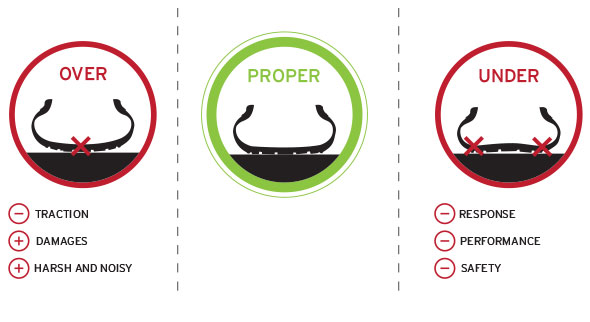
The perils of under- and over-inflation
An under-inflated tire will “flex” more when cornering and stopping. Under-inflated tires don't respond as quickly as they would if they were properly inflated, so you lose some of the performance and safety benefits built into the tire by the manufacturer. Over-inflated tires can lose traction because the shape of the tire actually becomes deformed by excessive air pressure, decreasing the tire’s footprint on the road. Over-inflated tires can be more prone to damage -- an over-inflated tire is stiffer and may not react as expected to common road hazards like potholes. And over-inflation can even give your vehicle a harsh, noisy ride. Nobody wants that, either.

Pressure drop! This under-inflated tireshows heavy wear on both shoulders. Check tire pressure once a month and fill as needed to reach the recommended inflation pressure.

When you drive on an over-inflated tire, the center of the tread can wear down. Check the tire pressure and release air until you reach the recommended inflation pressure.
Check tire pressure regularly, when tires are cold
We recommend that you check your tire pressure at least once a month, and also any time you’re planning to hit the road for a long drive. Check pressure while the tires are cold – for example, first thing in the morning. Heat generated by driving, an increase in air temperature as the day goes on, and even the heat of the sun shining on your tires can temporarily increase tire pressure, so you’ll get the most accurate reading when tires are cold.
Oh, and if you’re thinking of cheating a bit, sorry, but there’s no such thing as a visual tire pressure check. It's almost impossible to tell if a tire is under-inflated or over-inflated simply by looking at it. Use a quality tire gauge and if necessary, adjust the air pressure as indicated by the owner's manual or the vehicle tire placard (usually found on the driver’s side door jamb).
Can't find the recommended air pressure for your tires? Check out this article:
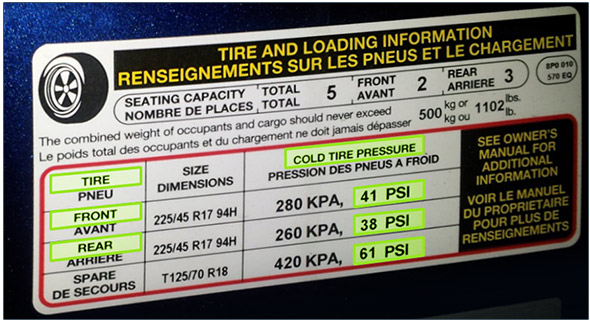
The tire information placard offers up all sorts of valuable information about your tires – in this case, proper inflation pressure, tire size, load and speed rating, and more.
Pressure cookers: Special circumstances
Off-roading
When traveling over rough terrain, mud, or deep sand, many off-roaders will “air down” (decrease tire pressure) to keep more of the tire’s footprint gripping the ground. They also decrease their speeds, since their tires will now be less responsive when it comes to steering and stopping. But driver beware … letting out too much air can damage tires or even cause the bead of the tire to roll right off the rim. Off-roaders also need to remember to air up before hitting the highway to head home.
Rock crawling
These super-extreme off-roaders love navigating over steep rocks, tall ledges, and other ultra-rugged features. Lowering tire pressure makes tires soft and pliable, so they can conform to the shape of the rocks, improving traction and even helping to smooth out what can be an extremely rough ride. Rock crawlers can sometimes decrease tire pressure into the single digits!
Road racing and autocross
Again, the goal here is to maximize the footprint of the tire on the ground. When racing, tires get hot and tire pressure increases, so racers compensate by constantly measuring “hot pressure” (immediately after a test run on the track), then fine-tuning pressure up or down to get the very best performance. Since autocross races are shorter, hot pressure isn’t as much of an issue, but all racers also need to take other factors into account in their calculations, like air temperature and track surface temperature. It’s a complicated process that requires constant tweaking, measuring, re-adjusting, and more checking to achieve the fastest lap times possible. Now aren’t you glad you only need to check tire pressure once a month?
Musical interlude
Studies show that people who sing “Pressure Drop” while checking tire pressure are 90% more likely to enjoy the task. Wearing a sparkly vest at the same time drives that number up to 100%.

