spikes entice emotions, gammar
Timing Is (Almost) Everything
With almost everything in life there is an element of seasonality to be considered before embarking on a particular activity, journey, or mission. For instance, when attempting to ascend a previously unconquered mountain you most likely want to first observe weather patterns throughout several seasons and then pick the best route at the best time – which combined will increase your odds of reaching that coveted peak. When planning a trip to Paris you will most likely consider spring or autumn instead of the dead of winter. Skiing in the Austrian Alps is best enjoyed in late fall or early spring and you won’t be finding many operating skilifts in mid June. So we can all agree that the concept of seasonality is deeply ingrained in our human nature and culture as it roots back throughout the millennia all the way to the very dawn of life on this planet.
As the financial markets are largely driven by human nature and human psychology it thus not surprising to observe a cyclical dimension which many scholars have devoted much time and effort quantifying. Ralph N. Elliott for instance is famous for his study of the wave principle in stock markets that is known today as the Elliot Wave Principle. In his comprehensive work he identified fractal bull and bust cycles which he recognized as patterns that appear to repeat themselves on various time intervals, from just a few minutes all the way to years, decades, and even centuries. Chris Carolan, a friend of the blog, wrote a fascinating book called the Spiral Calendar, which defines time intervals from a derived Fibonacci series based on moon cycles (29.53 days). The basic Spiral Calendar thesis is that emotional market turns are linked to past emotional market turns by Spiral Calendar time units in quantities greater than random. Although this may all sound highly exotic to the unexposed reader I would strongly recommend Chris’ work, which since has evolved into defining Solunar models for various markets (i.e. Dow, Gold, etc.). As a matter of fact much of what Volar and I present here today has been confirmed by Carolan’s work, despite the fact that Volar’s charts are purely statistical in nature. It’s always fascinating and a bit rewarding to have your own work supported by a completely different theory.
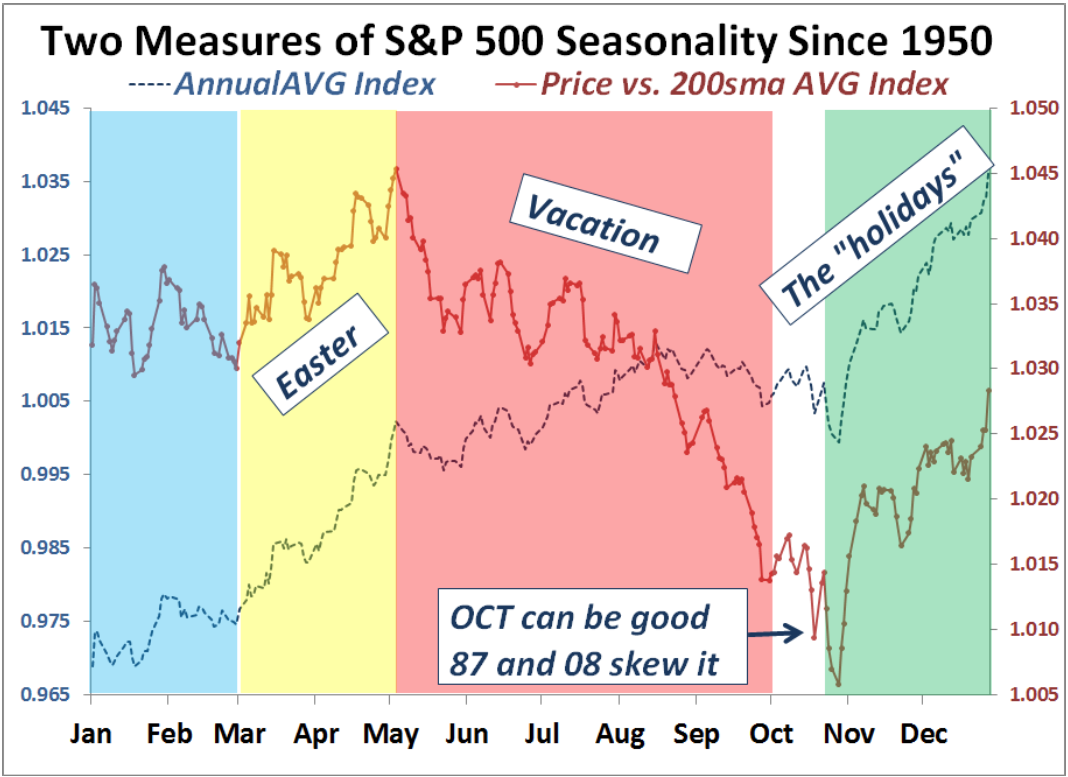
To boot here is a basic concept chart Volar produced a few weeks back – I really like how he used color codes to represent four main seasons throughout the trading year. As you can see we just entered the ‘vacation’ season and historically it averages to the downside. When compared to the 200-day SMA the rate of ascend during the vacation season is rather mild when compared with the Holidays or Easter seasons.
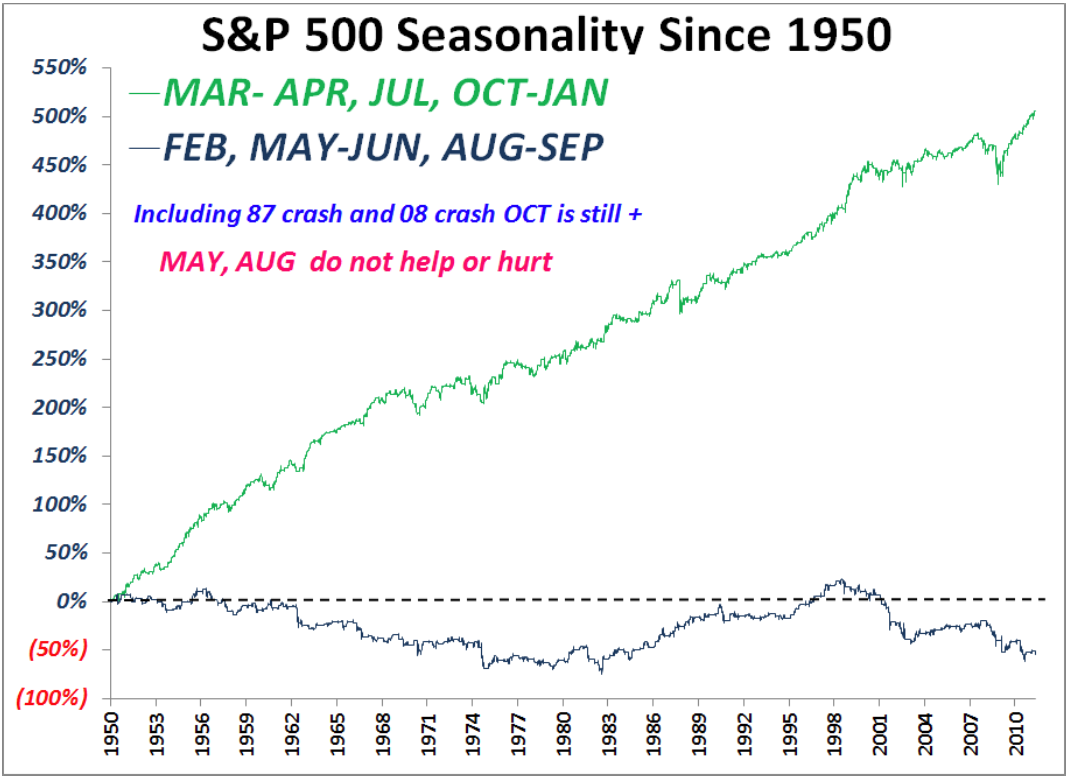
It thus no surprise to see this basic seasonality reflected in the chart above. Apparently being long between March – April, during July, and then again from October all the way through January appears to have clear statistical support. And yes, to my very own surprise October is often a pretty good month – once you exclude the 1987 and 2008 crashes.
But wait – we’re only getting warmed – go grab a cup of tea or java, there are plenty of charts to go:
Charts and commentary below for anyone donning a secret decoder ring. If you are interested in becoming a Gold member then don’t waste time and sign up here. And if you are a Zero subscriber it includes access to all Gold posts, so you actually get double the bang for your buck.
Please login or register for Zero Data Feed or Evil Speculator Gold or geronimo/ES or evil.rat/ES to view this content.


