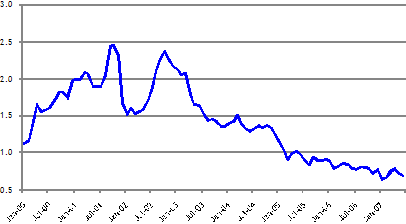


http://www.kansascityfed.org/publicat/research/indicatorsdata/KCFSI/kcfsi.sep.10.pdf http://www.sfgate.com/cgi-bin/article.cgi?f=/g/a/2010/10/11/investopedia6106.DTL&ao=2 What Went Wrong? The question then turns to what went wrong and why did investors sour so precipitously on what had become an apparently successful means to provide easy access to credit for the average American and bolster investor returns? The answer to this question is rather simple in that it involves the relationship between leverage and the cost thereof. Although Americans were more than happy to have easy access to credit cards, cars and home loans, it is unlikely they were aware this practice was placing the U.S.'s societal balance sheet in the most precarious position in its entire history. As you can see from Figure 2, total leverage in American society had not only reached its highest levels in history, but had done so at an accelerating pace in recent years. The result was our economy had become extremely addicted to leverage and overburdening unrealistic budget practices. Chart 2: Total Societal Leverage (Household, Farm, Corp. Government and Financial) - June 2007 Source: Federal Reserve One of the many problems in hindsight is that the Federal Reserve failed to take into consideration not only the incredible leverage inherent in our economy, but the reliance on low interest rates. Corporations were not the only parties dependent on low interest rates, home owners could only pay off their mortgage if rates remained low. Thus, they could not pay interest payments on their mortgages that exceeded the initial teaser rate. The shadow banking system enabled such a system to flourish because many of these economic anomalies remained hidden in the unregulated market. So with the dual effect of high 2008 energy costs (recall gasoline at around $4 per gallon) alongside the higher interest rates that followed the mortgage teaser rates, the economy began to sputter. But more importantly, investors began to discount a recession into their pricing of securities and willingness to bear risk. This in turn created a positive feedback loop that hit the economy with higher credit costs as investors now required greater compensation for bearing risk given the fragility of the U.S. economy and peoples' ability to service their interest payments. See Figure 3. Figure 3: Spread Between Moody's AAA and U.S. 10-Year Treasury Source Federal Reserve So the end of result of this confluence of events was exactly what the economy did not need. Investors were far less likely to lend money over fears over economic weakness and the shadow banking system essentially collapsed. So any lending that did take place was done at far higher interest rates than people were accustomed to. On top of this, the highly levered U.S. economy was not only unable to bear these precipitous increases in interest rates, but the lack of availability of credit in general. This is what led to the precipitous decline in U.S. economic activity, or the "Great Recession." See Figure 4. Figure 4: Total Borrowing/Lending in U.S. Economy And Annualized Real GDP Growth Source: Federal Reserve, BEA The Bottom Line The point of this article is two-fold. The first is to serve a big picture history lesson for what the shadow banking system was, what caused its failure, how that failure contributed to the 2008 economic woes, and also to provide a demonstration of how important this system is to our economy given societal leverage. Albeit people always seek to demonize someone or something when things go wrong, it's important to remember that the shadow banking system could never have existed if there had been no demand for its services - the demand created the supply. Like it or not, this aspect of our economy is essential given our country's penchant for borrowing to support consumer spending. Can we regulate it for the betterment of society and preclude such future meltdowns? Well, that remains to be seen. Original story - The Rise And Fall Of The Shadow Banking System Copyright (c) 2010 Investopedia ULC. All rights reserved. Investopedia.com is a Forbes Digital Company. Read more: http://www.sfgate.com/cgi-bin/article.cgi?f=/g/a/2010/10/11/investopedia6106.DTL&ao=2#ixzz12KcW9Vq2


