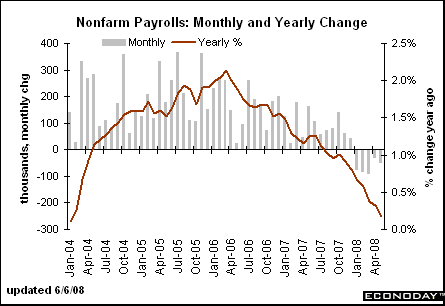
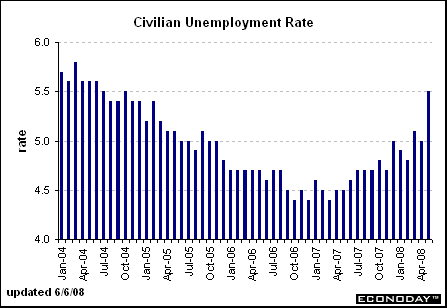
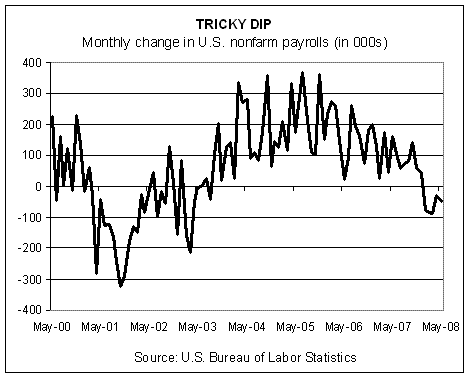
Highlights The May employment report showed a further declining labor sector but was mixed in terms of meeting expectations. The biggest surprise was a half a percentage point jump in the unemployment rate. Nonfarm payroll employment in May declined 49,000, following a decrease of 28,000 in April and a fall of 88,000 in March. May's dip in employment came in better than the market forecast for a 60,000 drop. The latest decrease was led by declines in construction, professional & business services, retail trade, and manufacturing. Revisions to March and April resulted in a net revision downward of 15,000. On the inflation front, average hourly earnings advanced 0.3 percent in May, coming in above the market projection for a 0.2 percent boost. Payroll job losses were widespread. Goods-producing jobs fell 57,000 with construction jobs declining 34,000 and manufacturing by 26,000. Mining edged up 3,000. Service-providing jobs were essentially flat with an 8,000 rise. Gains were seen in education & health services, up 54,000; government, up 17,000; and leisure & hospitality, up 12,000. Declines were seen in trade, transportation & utilities, down 41,000 and professional & business services, down 39,000. Turning to the household survey, the civilian unemployment rate spiked to 5.5 percent from 5.0 percent in April, coming in much worse than the expectation of 5.1 percent. The last time the unemployment rate jumped half a percentage point was February 1985 and the rate of 5.5 percent was last seen in October 2004. The latest jump in the unemployment rate reflected a 285,000 decline in household employment, a surge of 861,000 in unemployed, and a 577,000 boost in the labor force. The May spike could have been caused by seasonal adjustment difficulties in part as May is when some college students enter the labor market. If more students enter the market sooner than seasonal factors assume, that will not be fully taken into account. On a year-on-year basis, nonfarm payroll employment slipped to up 0.2 percent in May from up 0.3 percent in April. The average workweek was unchanged at 33.7 hours in May. For manufacturing, the average workweek also was unchanged in May at 41.0 hours. Aggregate hours in manufacturing slipped 0.2 percent in May, following a 1.0 percent fall the month before. The May jobs report clearly shows further deterioration in the labor sector, lessening the ability of the consumer to support economic growth. Payroll losses were widespread. The jump in unemployment may be exaggerated for technical reasons but nonetheless points to weakening in employment. Today's report has lowered the odds of a healthy rebound in economic growth later this year. Treasury yields fell on today's news and equities are likely to come under downward pressure. Market Consensus Before Announcement Nonfarm payroll employment has been on a mild downtrend in recent months but has not yet reached a pace consistent with recession. The small declines in employment are more consistent with flat growth rather than contraction as modest productivity gains still allow flat growth with slight decreases in employment. Nonfarm payroll employment in April slipped a slight 20,000, following a decline of 81,000 in March. The latest overall decrease was led by declines in construction, manufacturing, and retail trade, with decreases of 61,000, 46,000, and 27,000, respectively. On the inflation front, average hourly earnings rose a very modest 0.1 percent April while the average workweek edged down 0.1 hour to 33.7 hours in April. According to the household survey, the civilian unemployment rate slipped to 5.0 percent from 5.1 percent in March. Nonfarm payrolls Consensus Forecast for May 08: -60,000 Range: -150,000 to -10,000 Unemployment rate Consensus Forecast for May 08: 5.1 percent Range: 5.1 to 5.2 percent Average workweek Consensus Forecast for May 08: 33.7 hours Range: 33.6 to 33.8 hours Average hourly earnings Consensus Forecast for May 08: +0.2 percent Range: +0.1 to +0.4 percent
