


The world’s largest asset manager, BlackRock, has capped investor withdrawals from one of its flagship private credit funds. This move follows a surge in redemption requests that exceeded internal limits.
While the move affects a traditional finance (TradFi) vehicle, the liquidity pressures behind it could ripple into the Bitcoin and crypto markets.
BlackRock Caps Withdrawals as Redemption Requests Surge
BlackRock’s $26 billion HPS Corporate Lending Fund restricted withdrawals. According to the Financial Times, it follows investors requesting roughly $1.2 billion in redemptions, equivalent to 9.3% of the fund’s net asset value (NAV) during the quarter.
However, the semi-liquid fund allows only 5% quarterly withdrawals. This compels the firm to approve about $620 million in payouts while delaying the remaining investor redemption requests.
Private credit funds like the HPS vehicle typically invest in corporate loans that rarely trade on open markets.
As a result, they rely on withdrawal limits (gates) to prevent investors from withdrawing more cash than the underlying assets can readily provide.
The decision arrives amid broader pressure in the private credit industry as investors reassess the asset class. Recently, BeInCrypto reported that Blue Owl adjusted redemptions from its retail private debt fund.
Like in BlackRock’s case, Blue Owl’s move was related to rising withdrawal pressures.
Several funds have faced rising redemption requests following concerns about credit quality and declining returns.
A similar vehicle managed by Blackstone recently processed record withdrawal requests equivalent to 7.9% of shares, though the firm ultimately fulfilled all redemptions.
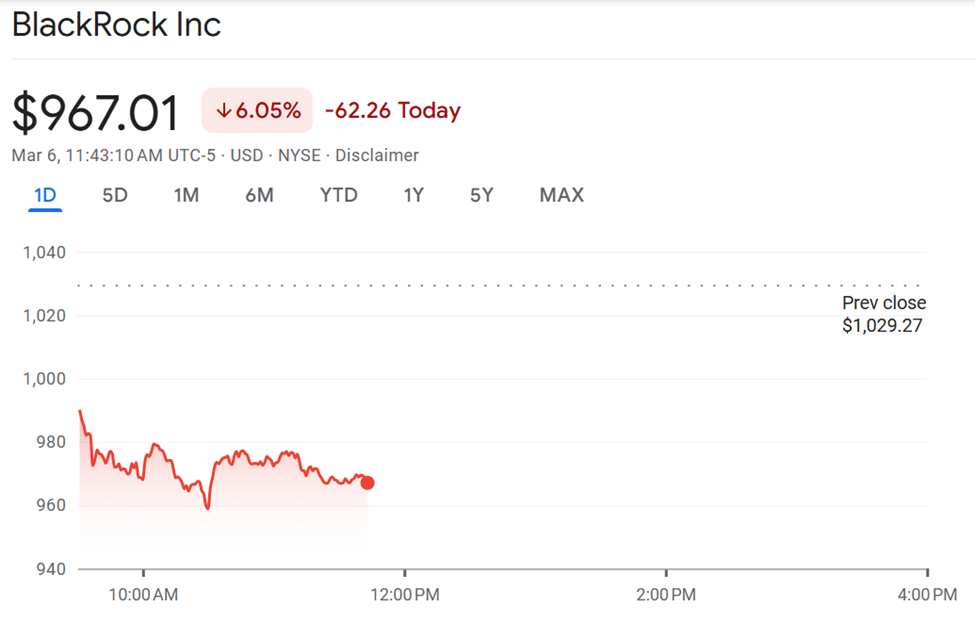
News of BlackRock’s withdrawal cap triggered an immediate market reaction. Shares of the asset manager reportedly fell around 6% at market open after reports of the restrictions circulated.
Liquidity Stress Could Spill into Crypto Markets
While the withdrawal cap affects a private credit fund, the implications extend far beyond TradFi.
“When giants like BlackRock lock the gates on private funds, it signals a ‘liquidity crunch.’ Investors stuck in private credit might sell their ‘liquid’ assets—Bitcoin and ETH—to raise cash elsewhere,” wrote investor Paul Barron.
In other words, if investors cannot access funds from illiquid private credit portfolios, they may turn to assets that can be sold instantly in public markets.
That list increasingly includes cryptocurrencies such as Bitcoin and Ethereum.
Such dynamics have emerged during past financial stress periods, when investors sold liquid holdings (stocks, gold, and crypto) to meet margin calls or cash needs.
Meanwhile, some analysts are concerned that the withdrawal limits could signal deeper stress across financial markets.
“This is a major red flag. Something big is coming,” said market analyst Jacob Kinge.
A New Debate Between CeFi and DeFi
Beyond potential liquidity spillovers, the situation has also reignited debate over the relative merits of TradFi and DeFi structures.
Barron argued that private credit funds illustrate the risks of centralized finance, where investors rely on managers to decide when capital can be withdrawn.
“In private credit, you’re at the mercy of the fund manager’s ‘gate,’” he said. “In DeFi, the liquidity is mostly transparent and code-governed.”
DeFi protocols that run on blockchain networks often use automated liquidity pools. Here, withdrawal rules are publicly visible and governed by smart contracts rather than asset managers.
Institutional Crypto Narrative May Strengthen
Despite short-term risks of liquidity-driven selling, stress in TradFi could ultimately strengthen the long-term case for blockchain-based financial infrastructure.
Periods of restricted liquidity in traditional markets often revive interest in alternatives that promise transparency, programmability, and 24/7 access. Market turbulence could accelerate the launch of new institutional crypto products in the future.
In the meantime, however, the situation shows how deeply interconnected global financial markets have become.
Even a withdrawal cap in a private credit fund could affect crypto traders watching liquidity flows across the broader financial system.
