原文链接:https://medium.com/@giorgioprovinciali/c69093afb23a?sk=505ed733ad7234e0d14b59393aae1db9
Deadlock In Geneva
By: Giorgio Provinciali
Live from Ukraine
Dnipro — The Geneva stalemate is not a diplomatic incident but the logical consequence of a war whose fundamental objectives Moscow never considered negotiable.
On February 18, 2022, the Ukrainian Ministry of Defense had already denounced 52 Russian violations of the ceasefire established by the Minsk agreements, all occurring on that day alone. Meanwhile, Moscow-backed terrorists in charge of the self-proclaimed ‘republics’ of Donetsk and Luhansk staged a mass evacuation of the local population to the Russian Federation, claiming that Ukrainian President Volodymyr Zelensky was about to order his military to go on the offensive in those territories. Absent from the Munich Security Conference, Vladimir Putin declared: «We will only negotiate with security guarantees».
The following day, two Ukrainian soldiers died of shrapnel wounds sustained in Russian attacks in Donbas. They were the first casualties of clashes fueled by Moscow as part of its planned full-scale invasion of Ukraine. Zelensky announced the news on the sidelines of the Munich Conference, reiterating his willingness to negotiate and even calling for the resumption of talks. «The only thing we want is peace», he said, reiterating his gratitude to Washington and calling for a diplomatic path. Despite already having lost swathes of territory the size of Switzerland, the Netherlands, or Belgium, Ukraine had respected the ceasefire agreed two years earlier under the Minsk agreements but had been bombed in response.
After another four years of bombing, negotiations within the political group in Geneva reached a stalemate on February 19, 2026. The reason lies in the positions expressed by Vladimir Medinsky, one of the most well-known ideologues and historical revisionists among the current Russian elite.
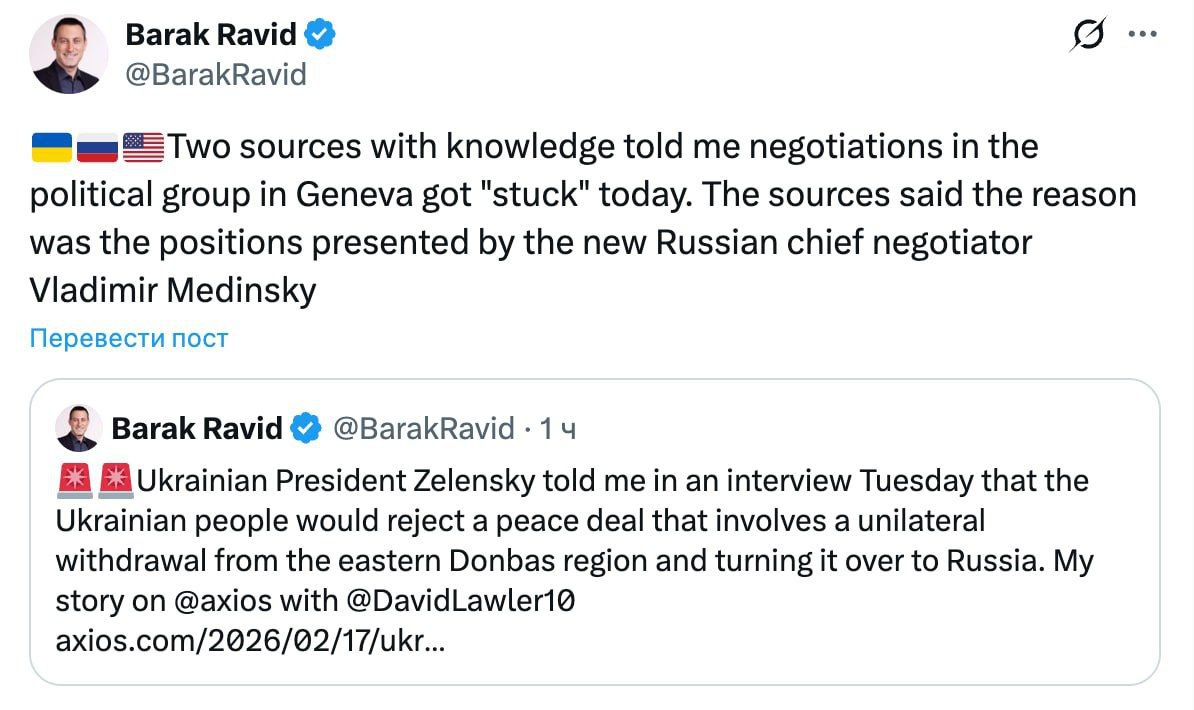
Zelensky is now declaring himself «willing to negotiate only in exchange for security guarantees», but the curious mirroring of the rhetorical positions between the parties is only apparent.
Four years ago, Putin used the notion of «security» in an offensive-strategic sense: he demanded guarantees regarding Ukraine’s non-Euro-Atlantic integration, the permanent neutralization of the Ukrainian state, and the recognition of an exclusive sphere of influence. ‘Security’ was therefore understood by Russia to be a limitation on others’ sovereignty.
Today, Zelensky uses the same linguistic formulation to express the opposite concept: preventing a repetition of the aggression against his country through concrete multilateral commitments and verifiable deterrence and prevention mechanisms.
The stalemate in Geneva, therefore, stems not from a lack of formal willingness to engage in dialogue but from the incompatibility of the preconditions.
The Russian positions conveyed by Medinsky continue to be based on a distorted historical reading that denies Ukraine’s full subjectivity, on the claim of freezing military results as a basis for negotiations, on the imposition of a permanent veto on Ukrainian strategic choices, and on the implicit demand for international legitimacy of Russian crimes.
The rereading of the historical events preceding February 24, 2022, that Alla Perdei and I have been proposing day by day in our latest articles, reveals that, after another four years of bombing, Ukraine cannot accept a ceasefire without structural guarantees. More broadly, the experience of the 2014–2022 period also demonstrates that a freeze without deterrence only leads to the aggressor’s rearmament.
It is precisely this experience that makes it impossible for Kyiv today to accept ambiguous formulas.
Negotiations work when both sides seek to reduce future uncertainty.
Here, the opposite occurs.
By presenting the war not as aggression but as a means of historical rectification, Medinsky embodies the Russian state's narrative function. He speaks of a «natural historical space», downplays or reinterprets the darkest pages of Soviet history, and denies Ukraine’s autonomy and historical identity, calling it an «artificial derivation».
This approach is consistent with the doctrine expressed by Vladimir Putin in his 2021 essay on the “historical unity of Russians and Ukrainians”, which presents Ukraine not as a full historical subject but as part of a Russian continuum.
Medinsky is therefore not a simple negotiator but the most faithful interpreter of rashism that Putin could bring to a table, destined for historic ratification, not compromise.

For Kyiv, accepting these conditions would entail relinquishing sovereignty and institutionalizing future vulnerability. For Moscow, renouncing these conditions would mean admitting the failure of the original strategic objective.
The balance is therefore blocked by a negative symmetry: both sides view the concession as an existential threat.
On February 19, 2022, Zelensky asked to unblock negotiations while Ukrainian soldiers were dying under bombs. Putin responded by demanding security guarantees.
As of February 19, 2026, negotiations remain stalled because the Russian conditions amount to the political legitimacy of those bombs, to which Zelensky responds by demanding security guarantees.
As long as Russia views negotiations as the ratification of a fait accompli and Ukraine views them as a means of preserving its sovereignty, every negotiating table — Monaco, Minsk, or Geneva — will remain structurally unstable.
This explains why, after four years, we are not only facing a failure of diplomacy but also the continuation of the war by other means.
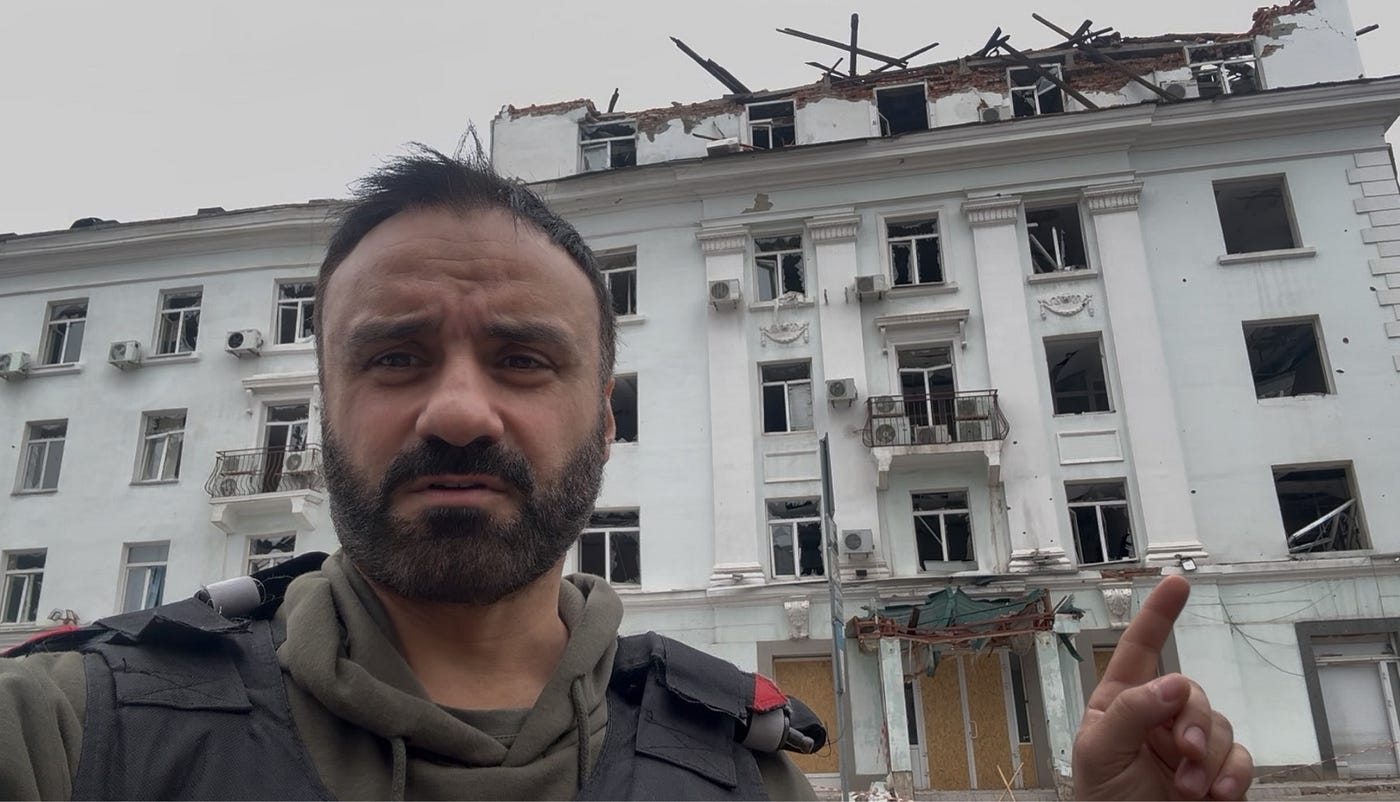
The ongoing blackouts severely damaged our house’s heating system in Western Ukraine while we were in the Donbas.
Without electricity, the pump couldn’t circulate the liquid while the fire was lit. As a result, the system caught fire, and the whole house was at risk of burning. Fortunately, it did not, but the whole system needs to be changed, and the house needs to be restored. Tubes are all bent, walls are blackened by haze, and the heating system doesn’t work, requiring an entirely new system.
We are doing our best since Alla’s parents live there, but there’s still a lot to work on here, too, as the people around us are in no better situation.
We’re renewing our fundraising campaign and thanking everyone who joins us in helping us restore what Russia is destroying. Even a small donation helps. We’ll keep you updated on developments.
Thank you all, dear friends
日内瓦僵局
作者:Giorgio Provinciali
翻译:旺财球球
乌克兰前线报道
第聂伯(Dnipro)——日内瓦的僵局不是一次外交事故,而是一场莫斯科从未把其根本目标视为可谈判事项的战争的逻辑后果。
2022年2月18日,乌克兰国防部已指控当天单日俄罗斯违反明斯克协议停火规定52次。与此同时,受莫斯科支持、掌控所谓“顿涅茨克和卢甘斯克共和国”的恐怖分子组织大规模疏散当地居民至俄罗斯,声称乌克兰总统弗拉基米尔·泽连斯基准备下令军队在那些地区发动进攻。缺席慕尼黑安全会议的弗拉基米尔·普京宣称:“我们只会在有安全保障的情况下谈判。”
次日,两名乌克兰士兵在顿巴斯遭俄方袭击中因弹片伤身亡。成为莫斯科为其预谋对乌克兰全面入侵所挑起冲突的首批伤亡。泽连斯基在慕尼黑会议间隙宣布了这一消息,重申愿意谈判,甚至呼吁恢复会谈。“我们唯一想要的是和平,”他表示,再次对华盛顿表示感谢并呼吁通过外交途径解决。尽管已失去相当于瑞士、荷兰或比利时面积的大块领土,乌克兰仍遵守两年前在明斯克协议下达成的停火,却换来轰炸。
经历又四年的轰炸,2026年2月19日,日内瓦政治小组的谈判陷入僵局。原因在于弗拉基米尔·梅金斯基所表达的立场——他是当代俄罗斯精英中最为知名的意识形态者与历史修正主义者之一。
(图片来源:X上的BarakRavid)
泽连斯基如今宣称“只在获得安全保障的情况下愿意谈判”,但双方在措辞上的表面镜像只是表象。
四年前,普京以进攻性战略的含义使用“安全”这一概念:他要求就乌克兰不加入欧洲—大西洋一体化、将乌克兰国家永久中立化以及承认俄罗斯的排他性势力范围给出保障。因此,在俄方理解中,“安全”被视为对他国主权的限制。
今天,泽连斯基用相同的措辞表达相反的概念:通过具体的多边承诺以及可核查的威慑与预防机制,防止对其国家的反复侵略。
(图:我们在基辅记录了这些画面——版权所有,Giorgio Provinciali)
因此,日内瓦僵局并非出自缺乏正式的对话意愿,而是源于前提条件的不兼容性。
梅丁斯基所传达的俄方立场仍基于扭曲的历史解读,否认乌克兰的完整主体性,主张以冻结军事成果作为谈判基础,强加对乌克兰战略选择的永久否决权,并隐含要求为俄罗斯犯罪获取国际合法性。
我与Alla Perdei在最近的文章中逐日重述的、对2022年2月24日之前历史事件的再解读显示:经过了又四年的轰炸,乌克兰无法在没有结构性保障的情况下接受停火。更广泛地看,2014–2022年的经验也证明:没有威慑的冻结只会导致侵略者的重整军备。
正是这一经验,使得基辅今天无法接受含糊的表述。
谈判在双方都寻求减少未来不确定性时才会奏效。
而这里,恰恰相反。
梅丁斯基通过将战争描述为历史纠正的手段而非侵略,体现了俄罗斯国家的话语功能。他谈论“自然的历史空间”,淡化或重新诠释苏联历史中最黑暗的篇章,否认乌克兰的自主性与历史认同,称其为“人造的衍生物”。
这种做法与弗拉基米尔·普京在2021年关于“俄罗斯人与乌克兰人历史统一”的文章中所表达的学说一致,该文将乌克兰呈现为俄罗斯连续体的一部分,而非一个完整的历史主体。
因此,梅丁斯基并非简单的谈判代表,而是普京可带到谈判桌上、用于历史性批准而非妥协的最忠实的“拉希斯姆”(rashism)诠释者。
(图:我在与“euro news”连线直播时的照片——图片来自“euro news”分享的视频)
对基辅而言,接受这些条件将等于放弃主权并使未来脆弱性制度化;对莫斯科而言,放弃这些条件则意味着承认最初战略目标的失败。
因此,平衡被一种消极的对称性所阻断:双方都将让步视为生存性威胁。
2022年2月19日,泽连斯基在乌克兰士兵仍在轰炸下牺牲之际请求打破谈判僵局;普京的回应是要求安全保障。
截至2026年2月19日,谈判仍然停滞不前,因为俄方的条件等同于为那些炸弹赋予政治合法性,而泽连斯基的回应是要求安全保障。
只要俄罗斯将谈判视为既成事实的批准,而乌克兰将其视为维护主权的手段,任何谈判桌——摩纳哥、明斯克或日内瓦——都将保持结构性不稳定。
这就解释了为什么在四年之后,我们面临的不仅是外交的失败,还是以其他方式延续的战争。
***
持续的停电严重损坏了我们在乌克兰西部的家中的供暖系统,而我们当时就在顿巴斯。
没有电,点着的炉火无法通过水泵循环热水。结果,系统起火,整个房子面临着烧毁的风险。幸而未被烧毁,但整个系统需要更换,房子也需要修复。管道都是歪的,墙壁被烟雾熏黑,供暖系统无法正常工作,需要彻底更换。
我们正在尽最大努力,因为Alla的父母住在那里,但这里还有许多工作要做,周围的人处境也好不到哪儿去。
我们正在重启筹款活动,感谢每一位支持我们修复被俄罗斯摧毁一切的朋友。即使是小额捐款也有帮助。我们会及时更新进展。
感谢大家,朋友们。
如果你相信我们的工作,请支持我们
在过去的三年里,我们一直在乌克兰战争的各个前线进行报道……
https://www.paypal.com/pools/c/9mFvpzKUrU