没有您的宝贵帮助,我们的声音将会被淹没。沉默。消亡。
感谢所有帮助分享我们文章的人。
Ukraine Can’t Break Through the Surovikin Lines, While Russia Stalls in Pokrovsk
By: Giorgio Provinciali
Live from Ukraine
WITHOUT YOUR PRECIOUS HELP, OUR VOICES WOULD REMAIN UNHEARD. SILENT. DEAD.
THANKS TO ALL WHO HELP US SHARE OUR ARTICLES.
(this ‘friend link’ will let you share this, overriding Medium’s paywall)
Chornivka — Writing from the Ukrainian defensive belt that, near Pokrovsk, holds the rest of Donbas and Ukraine in check, I explained in my latest dispatches from the front how that dense network of kilometers-long tunnels, hundreds of meters deep, now constitutes an impenetrable barrier for the Russian Armed Forces.

It took Moscow nearly two years and about eight hundred thousand men to run aground near Pokrovsk, which remains outside this system and over whose center the yellow-and-blue flag still flies, despite Kremlin propaganda claiming it has fallen for months.
Pokrovsk is located precisely 50 kilometers west of the previous Donbas stronghold: Avdiivka, where Putin’s ‘little green men’ were stopped in 2014. Having overcome that stronghold due to the halt of American supplies imposed by the Republican majority in the last midterm elections, twelve years and over 1.2 million dead and seriously injured later, the Russian army still hasn’t managed to capitalize on that ‘success’.

Just take a look at a map of Russian ‘conquests’ in 2025 to understand the Kremlin’s strategic failure. Calling that minor advance «a success» — which cost 400,000 men in just one year, along with equipment, missiles, ammunition, and vehicles — is nothing short of grotesque. It shows how baseless that and other outbursts from Donald Trump are, especially when compared to the destruction caused to civilian targets throughout Ukraine.
After reading delirious reports and assessments, evidently written from afar, I feel compelled to explain why Ukraine cannot advance beyond the so-called ‘Surovikin Lines’.
First of all, calling them ‘lines’ is inaccurate. They are a multi-layer defense system arranged in bands that extend up to 30 km across Ukrainian territories controlled by the Russian Federation.
The first band features continuous, high-density minefields, with anti-personnel and anti-tank mines laid so densely that an estimated 5 mines per linear meter can be found in the most critical areas. These are remote-controlled, redeployable devices launched with Zemledelie-I systems and repositioned every night by drones that monitor Ukrainian breach attempts. In the same zone are the dragon’s teeth (pyramidal reinforced concrete structures arranged in kilometers-long rows), zigzag trenches, and deep anti-tank ditches. To get a clear idea of this setup, just watch the footage of a similar Ukrainian system I recorded on various fronts of the war.
In the second zone, there are other minefields and trenches connecting numerous concrete bunkers, as well as positions for ATGMs, MGs, observers, and snipers who constantly monitor those first protected lines of communication.

In the third zone, there are semi-permanent artillery emplacements, depots, and internal supply routes, behind which rise artificial heights or elevations designed for observation and the launching of drones, and finally, mortars.
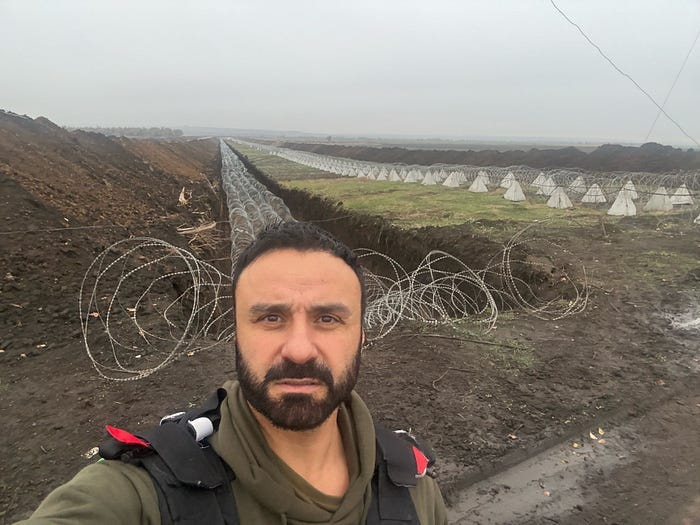
It goes without saying that mines play a crucial role. Moscow has millions, accumulated since the days of the USSR. Ukraine, on the other hand, has few, mostly received from the US after endless back-and-forth, and they are self-deactivating: after a preset period, they deactivate and need to be rearmed manually. This has caused disasters like the ones I mentioned from the Sumy front, when the Russians managed to break into the areas where I lived for a long time.


Furthermore, Ukraine has lost a significant portion of its mine-clearing vehicles, such as the URA-77, MICLIC, and Leopard 2R, making it difficult even to approach the first zone.
Beyond the overwhelming superiority in artillery, counter-battery fire, and missiles that I have repeatedly described, the Russians have continuous detection systems supported by Orlan, Zala, SuperCam, and Lancet drones, which systematically eliminate Ukrainian mine-clearing personnel and armored vehicles.
The new Russian laser-guided KAB glide bombs, now equipped with micro-turbojet engines, also target Ukrainian rear areas, which lack equivalent air-launched capabilities.


The most common mistake among analysts and remote reporters is to consider the Surovikin lines static.
They are dynamic: the Russians set up fortified positions every week, lay new mines immediately after neutralizing Ukrainian saboteurs and raiders, and rebuild any breaches they open in less than 24–48 hours.
This ensures that local successes like the one achieved at Robotyne never become strategic breakthroughs.
However, these defenses were built to resist an army without an air force, as Ukraine's was in 2022–2023. As long as Kyiv’s allies keep limiting their resources to prevent it from gaining air superiority, those defenses will stay unbreakable.
The Ukrainian military and political leaders understand this well. So much so that after many briefings with the General Staff, Volodymyr Zelensky launched a detailed review of the Ukrainian Air Force, ordering the production of hundreds of aircraft, including French Mirage-2000s and Swedish Gripens.
What I’ve written is supported by the material and testimonies I’ve collected in the field. Much of it is visible on La Ragione’s YouTube channel and website, and here on Medium. It’s important to emphasize this because nearly all the ‘experts’ keep discussing it without ever having set foot here.

THANKS TO ALL WHO BACK US IN THESE HARD TIMES
感谢所有在这段艰难时期支持我们的人
致任何相信我们工作并想支持它的人
在过去三年里,作为自由撰稿人,我们一直在乌克兰战争的所有前线进行报道,自从大规模……
https://www.paypal.com/pools/c/9k3lwAl8Wo
乌克兰无法突破苏罗维金防线,俄罗斯在波克罗夫斯克陷入停滞
作者:Giorgio Provinciali
乌克兰前线报道
乔尔尼夫卡——靠近波克罗夫斯克的乌克兰防御带对顿巴斯及乌克兰其他地区形成了制衡。我就在这个防御带中写作,在最新的前线报导中,我解释了那密集的、延绵数公里、深达数百米的隧道网络如何成为俄罗斯武装部队无法穿透的屏障。
(图:我在写这篇文章前的一刻,站在顿巴斯的隧道门口——版权所有,Giorgio Provinciali)
莫斯科花了近两年时间和约八十万人的军事力量,最终在波克罗夫斯克陷入困境,而俄军仍然没有渗透这个防御带,尽管克里姆林宫的宣传声称其已经在几个月前沦陷,但波克罗夫斯克市中心上空仍飘扬着黄蓝相间的国旗。
波克罗夫斯克位于前顿巴斯据点阿夫迪伊夫卡以西正好50公里,普京的“绿人”在2014年曾在此被阻挡。由于在上届中期选举中共和党多数派强制停止了美国的补给,俄军冲破了这个据点。经历了十二年战斗和超过120万的死伤后,俄罗斯军队仍未能在这一“成功”上取得实质性的战果。
(图:绿色显示阿夫迪伊夫卡。红色是波克罗夫斯克—OpenStreetMap的开源地图)
只需看看2025年俄罗斯“征服”的地图,就可以理解克里姆林宫的战略失败。将这一小规模的推进称为“成功”——代价是仅一年就损失了40万人,以及大量的装备、导弹、弹药和车辆——简直是荒谬至极。这表明唐纳德出普的言论和其他类似的狂言多么么有依据,尤其是与在乌克兰各地对平民目标造成的破坏相比。
(图:俄罗斯在2025年5月至12月期间的 “推进”——地图来源:Poulet Volant on X)
在阅读了那些显然是远程撰写的混乱报告和评估后,我感到有必要解释为什么乌克兰无法突破所谓的“苏罗维金防线”。
首先,将它们称为“防线”并不准确。它们是一个多层防御系统,以带状形式布置,在俄罗斯联邦控制的乌克兰领土上延伸达30公里。
第一层由连续、高密度的雷区组成,其中反步兵和反坦克地雷铺设得非常密集,最危险的区域估计每米长的线段就有5个地雷。这些地雷是使用Zemledelie-I系统发射的可遥控、可重新部署的装置,且每晚通过监控乌克兰突破尝试的无人机重新布置。在同一区域内,还设置有“龙牙”(呈金字塔状的加强混凝土结构,排成数公里长的行列)、锯齿形壕沟和深反坦克壕沟。要想清楚了解这种布置,只需观看我在战争各前线记录的乌克兰类似系统的画面即可。
在第二层,有其他雷区和壕沟连接着许多混凝土掩体,以及反坦克导弹、机枪、观察员和狙击手的阵地,他们会持续监视那些第一条保护通信线。
(图:Alla在顿巴斯防线附近报道,乌克兰人在夏季将防线升级,以减缓俄罗斯在顿涅茨克的推进——版权所有,Giorgio Provinciali)
在第三层,有半永久性的炮兵阵地、弹药库和内部补给路线,后面是用于观察和发射无人机的人工高地或高处,最后还有迫击炮。
(图:几天前,我在经过顿巴斯的乌克兰防线拍摄的照片——版权所有,Giorgio Provinciali)
不言而喻,地雷在这里发挥着至关重要的作用。自苏联时期开始积累,莫斯科现在拥有数百万枚地雷。而乌克兰的地雷数量则很少,主要是在经过无休止的反复谈判后从美国获得的,并且它们是自我失效的:在预设的时间段之后,这些地雷会失效,需要手动重新引爆。这导致了如我提到过的在苏梅前线那样的灾难,当时俄罗斯人成功突入了我长期居住的区域。
(图:我在库尔斯克行动期间给Alla拍下这张照片——版权所有,Giorgio Provinciali)
(图:Alla和我在库尔斯克前线的乌克兰战情室内——版权所有,Giorgio Provinciali)
(图:在接近库尔斯克前线时,我给Alla拍了这张照片——版权所有,Giorgio Provinciali)
此外,乌克兰已经失去了大量的排雷车辆,如URA-77、MICLIC和豹2R,这使得即使接近第一层防线也变得困难重重。
除了我多次描述的火炮、反炮火和导弹的压倒性优势外,俄罗斯还拥有由Orlan、Zala、SuperCam和Lancet无人机支持的连续侦测系统,这些无人机系统性地消灭乌克兰的排雷人员和装甲车辆。
新型的俄罗斯激光制导KAB滑翔炸弹,现在配备了微涡轮喷气发动机,也针对缺乏相应空投能力的乌克兰后方区域展开攻击。
(图片来源:Reuters)
(图片来源:Reuters)
分析师和远程记者最常犯的错误是将苏罗维金防线视为静态。
实际上,这些防线是动态的:俄罗斯每周都会设立加固阵地,在消灭乌克兰破坏和突击队后立即铺设新地雷,并在24到48小时内修复他们打开的任何缺口。
这确保了像在机器人取得的地方性成功永远不会演变为战略突破。
然而,这些防御工事是为抵御没有空军的军队而建造的,而乌克兰在2022年到2023年确实没有空中优势。只要基辅的盟友持续限制资源阻止乌克兰获得空中优势,这些防御将始终不可突破的。
乌克兰的军政领导人对此十分清楚。以至于在与总参谋部多次通报后,弗拉基米尔·泽连斯基启动了对乌克兰空军的详细审查,命令生产数百架飞机,包括法国的“幻影2000”和瑞典的“猛禽”战斗机。
我所写的内容得到了我在实地收集的材料和证词的支持。大部分内容可在La Ragione的YouTube频道和网站上,以及在Medium上均可见。强调这一点很重要,因为几乎所有的“专家”都在讨论这个话题,却从未亲自踏足这里。
(图:我在遭受俄罗斯袭击的前线附近——版权所有,Giorgio Provinciali)
